What is a Winch Solenoid and Why is it Used?
The safe and regular operation of a winch system on a boat depends not only on the motor's power but also on the correct switching of this power. This is where the winch solenoid comes into play. The solenoid, which plays a critical role in transferring the command given from the control panel, foot switch, or remote control to the motor, is the switching element that opens and closes the electrical flow in a controlled manner.
Especially in 12V and 24V winch systems, the correct solenoid selection is important for both system compatibility and operational stability. Incorrect voltage, wrong terminal structure, or selections unsuitable for the motor type can cause unbalanced operation in the winch circuit. Therefore, the solenoid is not just a small electrical part but one of the central components of the winch system.
What is a Solenoid?
A solenoid is an electromechanical switching element that creates a magnetic field when electricity is applied, moving the contacts inside its structure. In marine applications, this structure is used so that the winch motor, which draws high current, is not operated directly via a small button. In other words, the low-current command from the control opens or closes the main circuit via the solenoid; thus, the required power is safely directed to the motor.
Models used in winch systems can differ according to single-direction or double-direction logic. Double-direction solenoids have a switching arrangement that controls the motor's rotation direction for lowering and retrieving the chain. Therefore, products known as "reversing solenoids" are common in two-direction winch systems.
Why is a Winch Solenoid Used?
A winch motor can demand significant current the moment it starts operating. Carrying this load directly through a button, foot pedal, or thin control line is not suitable. The solenoid engages this high current without directly loading the user's control. Thus, the command side and the power side are separated.
In other words, the clearest answer to the question "Why do we need a solenoid?" is: to switch high current in a controlled and correct manner. Without a solenoid, managing the power flow to the winch motor safely and regularly becomes difficult. Especially in systems operated by remote control, panel, or foot switch, this component is one of the fundamental building blocks.
What Does a Winch Solenoid Do?
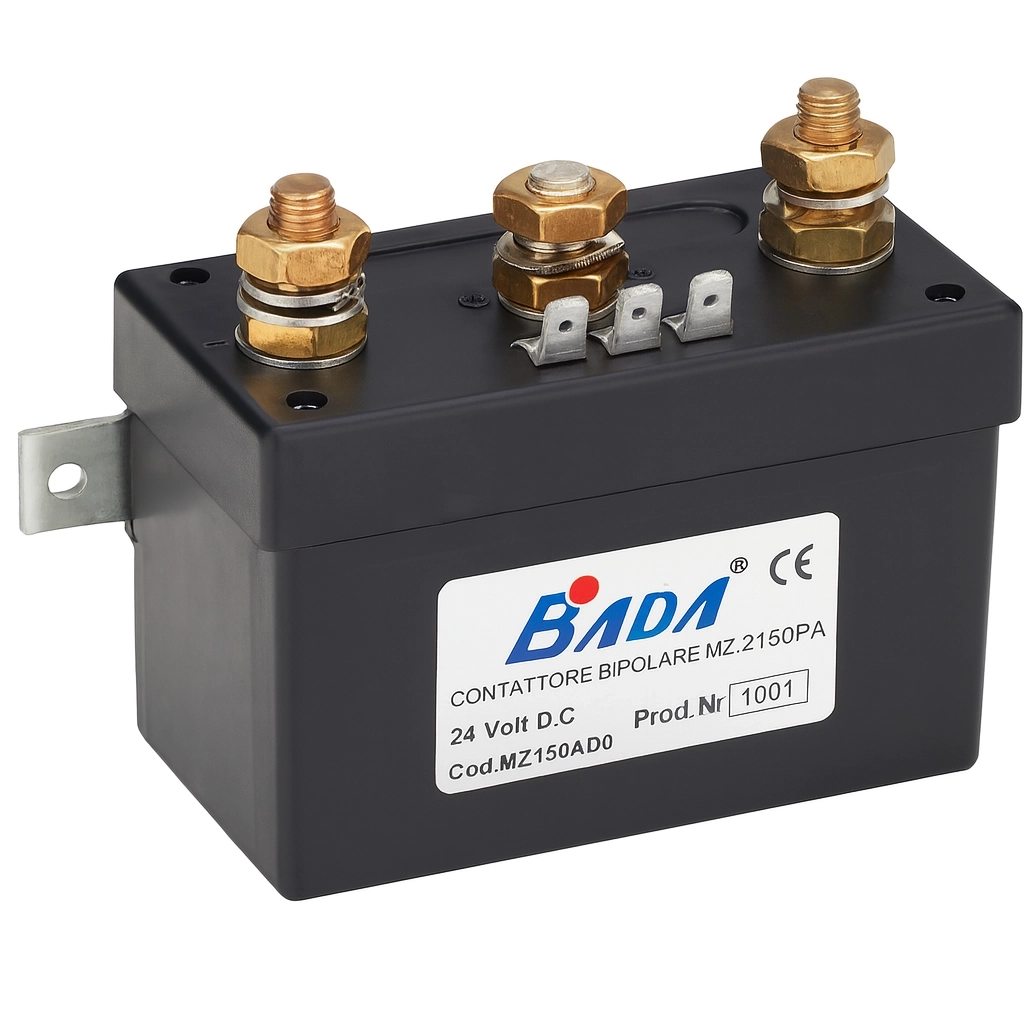
- It opens and closes the main current going to the winch motor.
- It acts as a switch between the control circuit and the motor circuit.
- It is involved in the direction control of the motor in double-direction systems.
- It provides an operating pattern suitable for 12V or 24V system structures.
- It is part of the connection infrastructure suitable for the motor type and terminal structure.
For this reason, the winch solenoid should not be considered merely as a part that "turns electricity on and off" but as a main component of the winch control chain.
Why are 12V, 24V, PM, SW, and Number of Terminals Important?
The first issue to be checked in solenoid selection is system voltage. If your winch motor is 12V, a suitable solenoid should be chosen; if it is 24V, a solenoid suitable for that should be preferred. As important as voltage compatibility is the motor structure. Marine solenoids can vary according to permanent magnet motors (PM), series wound motors (SW), and different terminal structures.
The expressions 3 terminals or 4 terminals found in product names are also important for this reason. Because the connection arrangement must be compatible with the terminal structure of the existing system. When selecting a solenoid, one must look not only at the brand and size but also at voltage, motor type, power range, and terminal structure together.
How to Make the Correct Solenoid Selection?
For correct product selection, several basic data in the system must be clear. First, it should be determined whether the existing winch motor is 12V or 24V. Then, the motor's structure, power range, and terminal arrangement should be checked. While some products match specific series or model families, others are separated according to wattage range and number of terminals.
Especially during service and part replacement processes, the following information is important:
- System voltage
- Motor type
- Watt or ampere value
- 3-terminal / 4-terminal connection structure
- Specific series or model compatibility
When this information is clear, winch solenoid selection proceeds much more healthily.